
SaltCure
Make bacon, pancetta, biltong, jerky and salami at home — without guessing the salt.
SaltCure is a meat curing calculator and batch tracker in one: it works out your cure to the gram, tracks every batch from day one to ready, and walks a first-timer through their first bacon without special gear.
Try the calculator in your browser


Three things it does
Dry and wet cure calculator
Equilibrium-percentage dosing for both methods, in grams or ounces, °C or °F. Change the meat weight and every figure follows.
Your nitrite standard, checked
Cure #1, Cure #2, peklosol, NPS or your own percentage — the dose is checked against USDA/FSIS limits. American calculators assume one standard; this one does not.
A log for every batch
Days and reminders, weight loss tracked against the target band, photos and a rating when it is done.
Recipes to start from
First-timer recipes with difficulty and timing, so a first bacon does not need special gear or a forum thread.
Inside the app
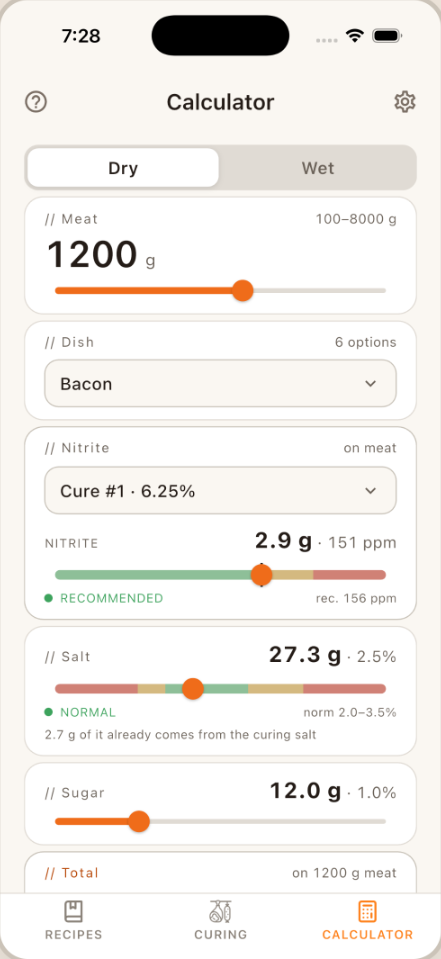
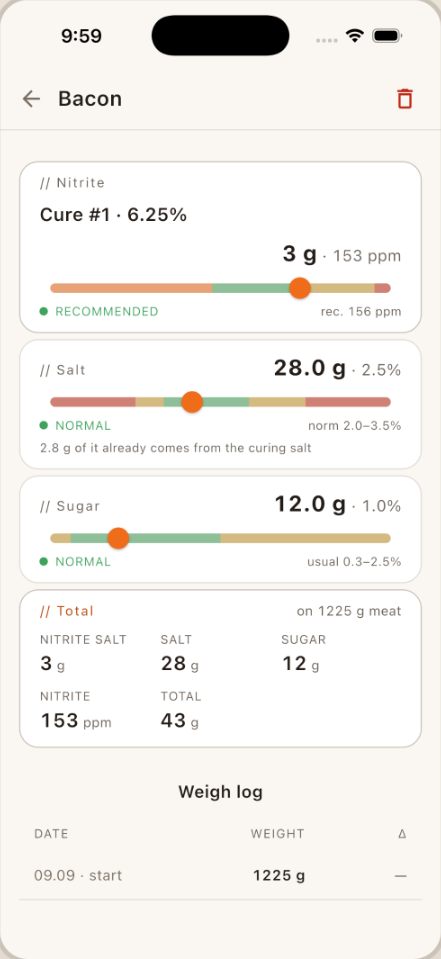
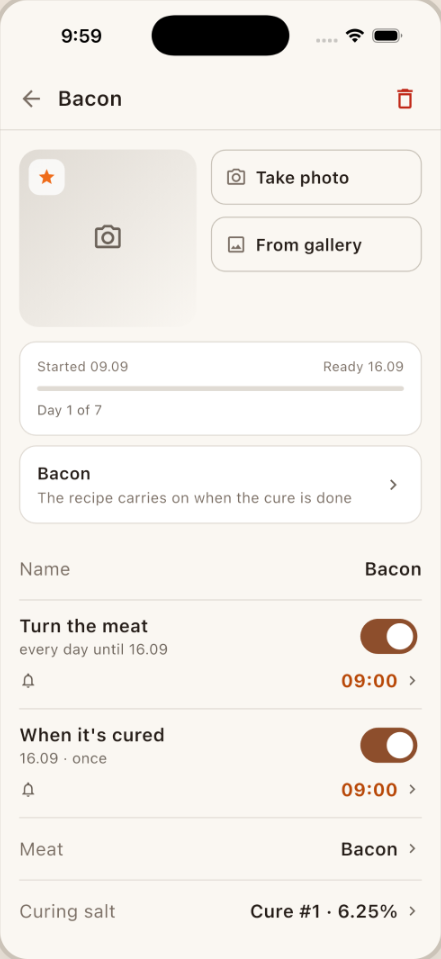
Questions about nitrite and safety
Why does the nitrite dose matter so much?
Nitrite in curing salt works together with salt and cold to hold back the growth of C. botulinum in cured meat, and it fixes the colour. It is not a guarantee, and too much nitrite is harmful. That is why the dose is weighed on a scale to 0.1 g, never measured by spoon. SaltCure calculates the dose in grams from the weight of your meat (for a wet brine, from the weight of the water).
Which limits does SaltCure use?
SaltCure calculates by the published USDA/FSIS rules (9 CFR 424.21 and 424.22). For bacon the ceiling is 200 ppm nitrite with dry cure and 120 ppm in a brine; for ground meat it is 156 ppm. For jerky made from whole muscle SaltCure deliberately applies the same stricter 156 ppm. The default dose is 156 ppm for dry-cured bacon and 120 ppm for brine. These rules were written for commercial plants, not home kitchens. We use them as the best public numeric reference, and the responsibility for the finished product stays with you.
Cure #1, Cure #2 or European curing salt — what is the difference?
Cure #1 contains 6.25% sodium nitrite. Cure #2 also contains sodium nitrate and is used for long dry-curing without cooking. European curing salt (Pökelsalz, peklosól) usually contains only 0.4–0.6% nitrite, roughly ten times less. If you pick the wrong type, the dose is off by about a factor of ten, so SaltCure asks which salt you have before it calculates anything, and you can enter the exact nitrite percentage from your pack.
Can I use Cure #2 on bacon?
No. USDA rules do not allow added nitrate in bacon, so SaltCure blocks Cure #2 for bacon completely.
Is drying enough for jerky?
No. For jerky the main risk is bacteria, not nitrite. FSIS guidance is to heat the meat to 160 °F (71 °C), poultry to 165 °F (74 °C), in a humid environment before drying, then dry at about 130–140 °F (54–60 °C).
How do I know if a batch has gone bad?
On long dry-cured whole cuts (such as pancetta or coppa), a white, fluffy mould is normal. Any other mould — green, black, or anything else — or a slimy surface means the whole batch should be thrown away. On other products (bacon, jerky, anything not dry-cured for weeks), any mould means discard. A clean look does not prove the meat is fine. When in doubt, throw it out.
Concept to store release
Context
A MordanSoft in-house product in the home curing and charcuterie niche. The existing apps in that category carry almost no reviews, which left an opening at the entry point.
What we did
Design, Flutter implementation, the dosing engine with FSIS limit checks, the batch log with reminders, first-run screens, and the release on Google Play and the App Store.
Numbers
Measurement in progress — first figures after the initial release window.
Stack
No catch. No subscription.
SaltCure works offline, keeps your batches on your phone, and does not ask for an account.